
Thursday, November 13, 2014
New & Improved
Please visit our exciting new website. This blog is no longer being maintained. Thank you for your continued support.


Friday, February 28, 2014
Living Wines Week!
LIVING WINES WEEK!
CELEBRATE & KEEP NATURAL WINE ALIVE!
We cordially invite you to a full week of free tastings that illustrate what we do here at Thirst. It starts tomorrow, Saturday March 1st at 5pm, with a class in which we'll pour pure, energetic wines that taste of the places they come from. We've also invited similar-minded friends in the wine world to pour wines they represent (see schedule below).
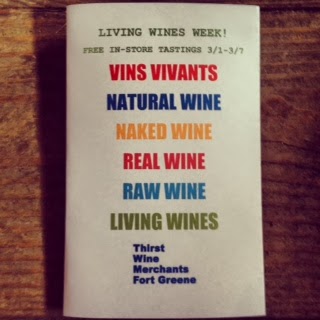 What are Living Wines?
Come see and taste for yourself. They're wines made with care in the vineyard by individuals who farm organically and/or biodynamically and who naturally ferment their wines with nothing added or taken away except, perhaps, a homeopathic dose of sulfur. These are the opposite of mass-produced wines that are commonly made with potentially hundreds of different additives and chemicals and often engineered with lab yeasts. We want to demonstrate the difference. Our goal is to bring you wines that are alive and give pleasure.
THE SCHEDULE
Saturday, 3/1, 5-7pm: Launch with Staff and A Thirst Merchant Selection or few
Sunday, 3/2 5-7pm: Byron Bates, Goatboy Selections
Monday, 3/3, 6-8pm: Kreso Petrekovic, Zev Rovine Selections
Tuesday, 3/4, 6-8pm: Maya Pedersen, Louis/Dressner Selections
Wednesday, 3/5, 6-8pm: Steven Plant, David Bowler Wine
Thursday, 3/6, 6-8pm: Chris Terrell, Terrell Wines
Friday, 3/7, 6-8pm: FINALE! (with a couple of surprises)
Tyler on why he likes working at our shop:
We sell the type of wine I like to drink.
There is no shortage of descriptors for the bottles which line our shelves, each suggesting a unifying theme for a wild, nuanced world of wine. At the end of the day, what matters is that the glass we fill contains a living, honest liquid which was extracted from the ground with both consideration and trust. I don't know if there's truly a word for that. To be honest, I'm not sure there needs to be.
The kinds of wine we sell - and, in turn, I drink - are the kinds of wine which interrupt a thought. They create a pause in conversation, they confront us, and we're forced to react. "How is this just grape juice?" We pour these wines, we take a sip, and then we look at the glass. "This is so freaking good." Of course, there's a lot more to it. Through our tastings this week, I hope that we can create a discussion about what exactly that is. We can talk about soil and sulfur and governmental regulations and fermentation and packaging and grapes and all of that. That stuff is really important. Until then, we can keep things simple.
I'm proud to sell wine which aren't afraid to make a statement. There is an energy in these bottles, and I have yet to find the right word for it. For now, I'll settle with "ours."
We cordially invite you to a full week of free tastings that illustrate what we do here at Thirst. It starts tomorrow, Saturday March 1st at 5pm, with a class in which we'll pour pure, energetic wines that taste of the places they come from. We've also invited similar-minded friends in the wine world to pour wines they represent (see schedule below).
Come see and taste for yourself. They're wines made with care in the vineyard by individuals who farm organically and/or biodynamically and who naturally ferment their wines with nothing added or taken away except, perhaps, a homeopathic dose of sulfur. These are the opposite of mass-produced wines that are commonly made with potentially hundreds of different additives and chemicals and often engineered with lab yeasts. We want to demonstrate the difference. Our goal is to bring you wines that are alive and give pleasure.
THE SCHEDULE
Saturday, 3/1, 5-7pm: Launch with Staff and A Thirst Merchant Selection or few
Sunday, 3/2 5-7pm: Byron Bates, Goatboy Selections
Monday, 3/3, 6-8pm: Kreso Petrekovic, Zev Rovine Selections
Tuesday, 3/4, 6-8pm: Maya Pedersen, Louis/Dressner Selections
Wednesday, 3/5, 6-8pm: Steven Plant, David Bowler Wine
Thursday, 3/6, 6-8pm: Chris Terrell, Terrell Wines
Friday, 3/7, 6-8pm: FINALE! (with a couple of surprises)
Tyler on why he likes working at our shop:
We sell the type of wine I like to drink.
There is no shortage of descriptors for the bottles which line our shelves, each suggesting a unifying theme for a wild, nuanced world of wine. At the end of the day, what matters is that the glass we fill contains a living, honest liquid which was extracted from the ground with both consideration and trust. I don't know if there's truly a word for that. To be honest, I'm not sure there needs to be.
The kinds of wine we sell - and, in turn, I drink - are the kinds of wine which interrupt a thought. They create a pause in conversation, they confront us, and we're forced to react. "How is this just grape juice?" We pour these wines, we take a sip, and then we look at the glass. "This is so freaking good." Of course, there's a lot more to it. Through our tastings this week, I hope that we can create a discussion about what exactly that is. We can talk about soil and sulfur and governmental regulations and fermentation and packaging and grapes and all of that. That stuff is really important. Until then, we can keep things simple.
I'm proud to sell wine which aren't afraid to make a statement. There is an energy in these bottles, and I have yet to find the right word for it. For now, I'll settle with "ours."
Tuesday, February 25, 2014
A Thirst Merchants Selection
This month we highlight a few of the wines we bring in directly. These are hand-made wines from quite small, independent, artisanal winemakers we discovered and whose wines we're especially proud to represent as “A Thirst Merchants Selection.”
The wines of Camille & Mathias Marquet and Francois Saint-Lo are honest, limited, small-batch -- so if you find that you really like them, BUY MORE before they disappear! This is the first time they are available in the US.
Chateau Lestignac, located in the Southwest of France in Bergerac, was almost sold when Camille and Mathias Marquet convinced their family to let them take it over. Their first vintage was 2008 and they immediately began by farming organically. They’re now certified organic by Ecocert and also apply biodynamic treatments.
After just one vintage of trying to listen to the advice of an oenologist, Camille and Matthias realized that they simply needed to trust their own instincts. The result: true Thirst wines with great purity and freshness but also deeply reflective of their terroir. As Mathias has eloquently put it: “Ce qui nous intéresse, c’est que le vin ait une personnalité.” [What interests us is wine that has a personality.] Their wines demonstrate that distinctive and profound wines can be made in lesser-known areas like Bergerac.
LESTIGNAC Les Abeilles des Collinettes 2012
Made from 60% Sauvignon Blanc and 40% Semillon, this fantastic white wine is lively on the palate with a chalky limestone minerality, pleasing citrus notes, and mouthwatering crispness. $18/bottle.
LESTIGNAC Le Rouge et Le Noir 2012
This vivid natural smoky red is a true wine of pleasure. It’s composed of 95% Cabernet Franc and 5% Merlot from grapes grown on clay soil. $18/bottle.
Francois Saint-Lo is a young winemaker whose first vintage was 2012. He was born in Normandy and his family was not involved with winemaking. However, he became passionately interested in working the vines and making wine and apprenticed with Olivier Cousin, among others. He has managed to buy a piece of land in the Anjou region of the Loire Valley with troglodyte caves, get a few hectares of vines, and immediately turn out stellar wines. Later this year we will also have his Chenin Blanc, Grolleau, Gamay as well as white and rose pet-nats. Francois’ wines achieve an elegant balance and a taste of place that gives us a feeling of deja vu. Tasting his wines we are reminded why we fell in love with the Loire in the first place.
FRANCOIS SAINT-LO On L’Aime Nature 2012
We discovered Francois last year when we tasted samples of his wines at the Raw Wine Fair in London that had not yet finished fermenting and immediately committed to bringing in his wines. 2012 is his first vintage. His patience and gentleness is reflected in the stunning purity of his wines. His Cabernet Franc has a liveliness on the palate, there's a beautiful honesty to it, and gentle tannins. Aaron Ayscough in his excellent blog, Not Drinking Poison in Paris, describes it as "shimmeringly elegant, a real see-through dress of a red wine." $22/bottle.
The wines of Camille & Mathias Marquet and Francois Saint-Lo are honest, limited, small-batch -- so if you find that you really like them, BUY MORE before they disappear! This is the first time they are available in the US.
 |
| Mathias Marquet |
After just one vintage of trying to listen to the advice of an oenologist, Camille and Matthias realized that they simply needed to trust their own instincts. The result: true Thirst wines with great purity and freshness but also deeply reflective of their terroir. As Mathias has eloquently put it: “Ce qui nous intéresse, c’est que le vin ait une personnalité.” [What interests us is wine that has a personality.] Their wines demonstrate that distinctive and profound wines can be made in lesser-known areas like Bergerac.
LESTIGNAC Les Abeilles des Collinettes 2012
Made from 60% Sauvignon Blanc and 40% Semillon, this fantastic white wine is lively on the palate with a chalky limestone minerality, pleasing citrus notes, and mouthwatering crispness. $18/bottle.
LESTIGNAC Le Rouge et Le Noir 2012
This vivid natural smoky red is a true wine of pleasure. It’s composed of 95% Cabernet Franc and 5% Merlot from grapes grown on clay soil. $18/bottle.
 |
| Francois Saint-Lo |
Francois Saint-Lo is a young winemaker whose first vintage was 2012. He was born in Normandy and his family was not involved with winemaking. However, he became passionately interested in working the vines and making wine and apprenticed with Olivier Cousin, among others. He has managed to buy a piece of land in the Anjou region of the Loire Valley with troglodyte caves, get a few hectares of vines, and immediately turn out stellar wines. Later this year we will also have his Chenin Blanc, Grolleau, Gamay as well as white and rose pet-nats. Francois’ wines achieve an elegant balance and a taste of place that gives us a feeling of deja vu. Tasting his wines we are reminded why we fell in love with the Loire in the first place.
We discovered Francois last year when we tasted samples of his wines at the Raw Wine Fair in London that had not yet finished fermenting and immediately committed to bringing in his wines. 2012 is his first vintage. His patience and gentleness is reflected in the stunning purity of his wines. His Cabernet Franc has a liveliness on the palate, there's a beautiful honesty to it, and gentle tannins. Aaron Ayscough in his excellent blog, Not Drinking Poison in Paris, describes it as "shimmeringly elegant, a real see-through dress of a red wine." $22/bottle.
Friday, January 10, 2014
Eruptions: Chiara Vigo and Frank Cornelissen
JANUARY WINE CLUB OFFERING! Sign up now to get the following two wines for $50.
Etna, Oh Etna, or Raw and Rawer
Etna, Oh Etna, or Raw and Rawer
This month we take you to
Sicily by offering you two red wines that are informed by the eruptions of the
volcano that is Mount Etna. These distinctive wines, made from grapes grown in volcanic soil, are made with a deep respect for tradition by two strong
personalities who bring a fresh perspective to this ancient winegrowing region:
Frank Cornelissen, a Belgian who moved to Sicily to make wine, and Chiara Vigo
who returned from her studies, in Bologna, Venice and Paris, to make wine at home.
 |
| Frank Cornelissen at The Raw Wine Fair in 2013 |
Frank Cornelissen makes his wine high up on
the slopes of Mount Etna. He chose this location first and foremost because he
feels Etna is a great terroir for the indigenous Nerello Mascalese grape; that in this place he could make wine that rivals the best Burgundies and Barolos. Frank in
fact feels that Nerello possesses the fruit of Pinot Noir and the dry tannins
of Nebbiolo. A sort of Zen Master, Frank believes that we can never fully
understand nature and all of its complexities and paradoxes. He doesn't use any chemical additions or treatments. He practices polyculture on his
15-hectare estate, growing olives for oil, buckwheat and fruit in addition to
the grapes for his wine.
Grapes are harvested by
hand, from mid-October to early November, in order to get the ripest fruit.
They then undergo meticulous selection and any unripe or damaged grapes are
discarded. In the cellar, the winemaking is completely natural, with no yeasts,
sulfites or chemicals added to the wines. The wines are then fermented with
their skins in small neutral tubs to insure stable temperatures. After
fermentation, the wines are pressed and stored in neutral vessels, big tanks
for the early-bottled wines and epoxy-lined anforas buried in volcanic rock for
the more tannic wines.
FRANK CORNELISSEN MUNJABEL CONTADINO 10 2012
Contadino is Frank’s homage to the farmer wines of the area. It’s a field-blend of 70-80% Nerello Mascalese with all kinds of local varietals from his old-vine vineyards: Alicante Bouschet, Minella Nera, Uva Francesa, Sangiovese, Minella Bianco and Insolia. It’s a dangerously drinkable wine that has the character of Etna: fragrant, profound, tannic but fruity.
Contadino is Frank’s homage to the farmer wines of the area. It’s a field-blend of 70-80% Nerello Mascalese with all kinds of local varietals from his old-vine vineyards: Alicante Bouschet, Minella Nera, Uva Francesa, Sangiovese, Minella Bianco and Insolia. It’s a dangerously drinkable wine that has the character of Etna: fragrant, profound, tannic but fruity.
 |
| Chiara Vigo |
Chiara Vigo is the
winemaker at her family’s estate, Fattorie Romeo del Castello. She was a small child in 1981 when Mount Etna erupted. Her
parents sent her away to safety but they stayed to monitor the situation. They
watched as the lava flow headed directly for their house; then it miraculously
shifted and went toward the river instead, destroying a substantial amount of
their property but not the full-on tragedy it could have been.
FATTORIE ROMEO DEL CASTELLO ALLEGRACORE ETNA ROSSO 2010
Chemicals have never been
used here and Chiara continues to work in the manner of her ancestors. Salvo
Foti, an influential Sicilian winemaker, has been a mentor. He encouraged her
to take over winemaking duties from him, impressing upon her how special her
vineyards are, and reminding her that she was born to be the winemaker at Fattorie Romeo Del Castello.
Allegracore is the name of
the parcel the grapes come from and it means happy heart. The wine is primarily
Nerello Mascalese aged in stainless steel. It has depth and also a certain
elegance. The tannins are there but gentle on the palate.
Sunday, November 24, 2013
Staff Picks for Thanksgiving!
Eric Asimov rightly
points out in the New York Times this week that wines for Thanksgiving should
be versatile, full of energy, invigorating, lower in alcohol, zesty, fresh and
bright. He adds, and we couldn't agree more, that "nothing is worse than
running out of wine, except running out of food. Figure a bottle per
adult." (Also Julia Childs' rule of thumb.)
 |
| "The First Thanksgiving" by Jean Louis Gerome Ferris (Courtesy: Wikipedia) |
We asked Tim and Tyler
to put together their dream six-packs. (5% off on them while they last. Supplies
are limited.)
TIM'S PICKS
Domaine Valentin Zusslin Cremant d'Alsace Rose Brut Zero NV
With a long winemaking
history dating back to 1691, Domaine Valentin Zusslin knows a thing or two
about crafting some serious, and seriously delicious, wines. The brother and
sister duo of Marie and Jean-Paul Zusslin oversee the farming, which has been
certified biodynamic since 1997, and also the non-interventionist winemaking
that follows after the grapes have been painstakingly hand harvested. Their
rose Cremant d'Alsace is but one of their many amazing wines. Made from 100%
Pinot Noir sourced from their walled-in Clos Liebenberg vineyard, it is pretty
close to immaculate. Wild berry fruits abound and a hint of grapefruit lead
into an exquisitely delicate experience in the mouth. Would be perfect for a
holiday brunch with friends, an aperitif while cooking, or to pair with an
assortment of desserts. $32/bottle
Broc Cellars Valdiguie 2012
Haven't heard of
Valdiguie? Don't worry, not many other people have either. After having been
mistakenly called Napa Gamay for decades, it took a young winemaker by the name
of Chris Brockway to set the record straight. Brockway opened the doors to his
winery located in Berkeley, CA in 2008 after having released vintages made
elsewhere. Since then he has proven that Valdiguie is a grape to be reckoned
with. He buys only biodynamically grown grapes from farmers in Solano County
and is ardent to employ minimal intervention in the winery. His 2012 Valdiguie
is incredibly precise and vivid with ripe red berry fruits and lovely buoyancy
that leads into a subtly earthy finish. This wine would feel right at home next
to your Thanksgiving feast or served slightly chilled and paired with cheeses
and charcuterie. $27/bottle
Remi and Laurence Dufaitre 'L'Air de Rien' 2011
Remi and Laurence have
been enthusiastically producing some incredibly pure wines in the Beaujolais
since 2001 when they founded their Domaine de Botheland. The domaine now
encompasses 12 acres in Saint-Etienne-des-Oullieres and is the only winery that
is embracing the natural way of making wines in that region. Their L'air de
Rien Beaujolais-Villages cuvee uses Gamay grapes sourced from low-yielding old
vines and they are harvested at the height of maturity resulting in a fuller,
riper Beaujolais that is tantalizing. Velvety fruit and an underlying
minerality make this wine a pleasure to drink with or without food and would
make a lovely addition to any occasion this holiday season. $22/bottle
Jean-Marie Berrux 'Le Petit Tetu' 2011
Leaving his job in Paris
behind, Jean-Marie Berrux began his journey in the world of wine in 1999.
However it wasn't until 2007 when he joined forces with Jean-Pascal Sarnin to
create Maison Sarnin-Berrux. For the wines they collaborate on they buy only
organically grown grapes and they have now produce nine cuvees labeled under
various appellations within Burgundy. In addition to those wines, Jean-Marie
makes a special cuvee from his very small plot of Chardonnay vines just outside
of Puligny-Montrachet that he maintains himself. Le Petit Tetu, or Little
Stubborn One, is incredible: unctuous with a blast of sea-like minerals
followed by pear, apple and apricots. It also has a ravishing acidity that
almost has this wine begging to be placed on your table this year. $30/bottle
Frank Cornilessen 'Susucaru 5'
After having cultivated
a career as a wine merchant in his native Belgium, Cornilessen decided to take
the ultimate risk and relocated to the wild and beautiful slopes of Mt. Etna in
Sicily. His first vintage in 2001 was a scant 500 bottles of naturally made
wine: no additives, no sulphur--just pure juice. He now produces around 2500
cases, although he now has his organic certification and a new, almost
finished, winery that is being built on his property. The Susucaru rose is a
co-fermentation of red and white varietals, most native to the very slopes
Cornilessen farms. Rose petals, red berries, wet stones and hints of juniper
berry and orange rind coalesce into a wonderfully intense bouquet. It maintains
bright, fresh berries throughout and its freshness stays with you long after
you've finished your glass. Pop the stopper on this wine and enjoy it with
cheeses or various vegetable dishes. $27/bottle
Domaine du Clos d'Elu 'Les Petites Gorgees' 2012
Many years of touring
and working in various wine regions around the world led Thomas Carsin to plant
himself in the heart of the Loire Valley in 2008. He has been working to
cultivate the land in harmony with nature and has been working to achieve
organic certification since 2010. Joined by longtime friend Greg du Bouexic and
a team of workers who have deep roots in the region, the domaine has set out to
craft some delicious, naturally made wines. Les Petites Gorgees is a red blend
of mostly Cabernet Franc with a few other varietals and is thirst quenching,
making it perfect for those long, sit-down holiday meals. Dusty berry fruits
and dark plums make this wine lush, mouth filling and pleasantly tart. Grab a
few bottles on your way to a friend's party or stock up to pair with a Thanksgiving
feast. $14/bottle
TYLER'S PICKS
Causse Marines Gaillac 'Peyrouzelles' 2011
If you've been in the
shop recently, you've probably heard me talk about an "in-law wine."
It's a bottle which is unapologetically unique but won't, in turn, scare away your
plonk-sipping relatives.
Hailing from Southwest
France, The Peyrouzelles is a 30/30/30 blend of Syrah, Duras, and Braucol.
Spicy aromas give way to deep fruit; the wine is lively with some
granite-tinged elements and a clean, almost-herbal finish. It's funky but
balanced and far more approachable than you'd think. Best served with something
spicy, and in great quantities.
Switch out everybody at
the Thanksgiving table's Malbec for a glass of the Causse Marines and wait for
'em to start preaching the gospel. Tell your in-laws that we have a bottle
waiting for them. $19/bottle
Julie Balagny Fleurie 'Carioca' 2011
I prescribe 750ml of Cru
Beaujolais to anyone who has ever had to drink bad wine on Thanksgiving. You
wouldn't be wrong to start with this bottle from Fleurie by young winemaker
Julie Balagny.
This Gamay is about finesse. It's deceptively light; the deep
fruit fills the palette so wholly and yet seems so buoyant! It lingers and
deepens and tastes a little different with each sip, with a nice zip of acidity
to cut through the food.
So sad a realization that the bottle is empty, yet
such a relief that you can ask for a case for Christmas! $28/bottle
Mas Coutelou 'Vin des Amis' 2012
Our friend Camille
imports only enough wines to fill both sides of a piece of paper. She's got a
real knack for it, too, as I have yet to have a sub-delicious bottle of hers.
She brings in this little devil, a blend of three-quarters Grenache and a
quarter of Syrah. It's a little lighter at first, finishing off with a kiss of
spice.
I'd like to pair it with
something in particular, but the truth is this: you should be drinking this
wine from the moment you read this wine until either Grandpa falls asleep,
football tears apart the entire family, or Mom begs you to come help with
dishes (whichever comes last.)
No, but seriously: this wine is good with
everything. Godspeed! $18/bottle
Domaine Faillenc Sainte Marie Corbières 'Pas des Louves' 2011
I have to admit, I
have a little crush on Corbières. Located within the Languedoc in southern
France, this AOC boasts a fair number of -- well -- diamonds in the rough. The
story here is quality, character, and affordability.
The four grapes which
comprise the 'Pas des Louves' are pressed and vinified together, which makes
sense in the glass. Like a perfume, you catch different notes depending on the
breath. The wine is alive with farm notes, from floral aromas to a finish full
of straw and herbs. It'd be great to start a dinner with this one; it's charming
and easygoing, which is more than I can say about some of my relatives. Pass
the bottle? $15/bottle
Nicolas Reau 'Attention Chenin Méchant' 2011
The winemaker was a
rugby player before, and I'm as glad as his mother that he changed trades when
his did. Reau's wines are expressive, clean, and downright delicious -- not to
mention solid examples of wine made naturally.
This Chenin Blanc has an
electric feeling to it -- you get some great acidity along with a hint of honey
tones. Medium-bodied, it deserves to cut the line as an Official Turkey
Pairing.
If Sancerre is your aunt who tells the same story year after
year, this Chenin is your cousin's new boyfriend who seems quiet at first but
ends up winning over the entire family with raunchy jokes and has Grandma
swooning at the same time. $21/bottle
Jean-Yves Peron 'Cidre des Cimes' 2010-11
We've sold a good share
of wines by Peron at the shop, and I think it's safe to say he's a favorite of
ours. Here we have a cider made by him in the mountains of eastern France,
where he does his magic.
Before anything else, let's talk about the gorgeous
gunk in the bottle. (I'm really selling this, aren't I?) Yes, there is
sediment. Yes, it dances around a bit. Yes, it's safe. Anyway, this is a pretty
serious cider: a heap of acidity, a rush of tiny bubbles, and a rustic sort of
feeling that works so very well with food. Forget Champagne and pop a bottle or
three of these.
Low in alcohol, this is the kind of bottle that can wander
around the Thanksgiving table easily. And if you're one of those cool
relatives, you'll let it wander over to the veteran inhabitants of the kids'
table without noticing. $18/bottle
WE DELIVER.
To order
click here or call 718-596-7643. To view
our full selection come see us at the store.
Monday, October 14, 2013
La Gramiere! Why La Gramiere.
 |
| Amy Lillard and Matt Kling |
When we visited London in May to attend the Raw Wine Fair we met up again with Amy from La Gramiere who was showing her wines. We have always admired what she and her husband Matt did.
Matt and
Amy met at the Kermit Lynch retail shop in Berkeley. Amy worked at the store
and Matt was a customer. In 2005 they left the Bay Area and moved to a small
town in the Southern Rhone 20 minutes outside of Avignon, where they bought
3.75 hectares of vineyards in the Cotes du Rhone, and a small house, and
started making wine.
Well not
exactly. Long story short they did make the wine, but not without a lot of
sacrifice and a lot of determination. They do almost all of the work
themselves, with occasional help from their friends and family at harvest. The
grapes are hand-picked, without anything added or taken away. They cultivate
without herbicides or pesticides and vinify in concrete vats with naturally
occurring yeasts. The result: a true wine of place made mostly of Grenache with
a little Syrah and Mourvedre.
It's
lively and fresh, peppery, with supple tannins. Originally imported by Kermit
Lynch, Amy told us her wines were currently unavailable in New York. So we
wondered how we could do the situation justice and decided to bring them in
ourselves! Hence our first Thirst Merchants Selection is born. The La
Gramiere Green Label 2011 is just $15/bottle and $13.50/bottle when you
buy a case (in store only).
Going forward we will share some of
our other finds with you. We will soon have an e-commerce site up and running.
As you may know by dropping by our little store in Fort Greene, Brooklyn, we
love those wines that are made in such tiny quantities that essentially if
you're not aware that they're currently available you might miss out!
THIRST
TOTE BAGS ARE BACK!
For a limited time, get one of our
classic totes FREE when you purchase 6 or more bottles.

Tuesday, August 6, 2013
It's Not Too Late
Our wine club offers two exceptional and unusual wines from the Arbois region
of the Jura from two of our favorite producers. Arbois was the first place the
French gave appellation status in 1936. Each wine, one white and one red, is
made from the local red grape Poulsard – in the town of Pupillin they confusingly
call it Ploussard. Poulsard is found almost exclusively in the Jura where it’s
been grown since at least the 15th century.
The Jura
is located between Burgundy and Switzerland. It has a cool climate and is known
for producing distinctive wines. The weather here is similar to Burgundy but
colder and therefore the harvest happens later.

Domaine
de l’Octavin “Cul Rond a la cuisse rose” 2011
This domaine is a collaboration between Alice Bouvot and Charles Dagand.
They began with two hectares in 2005 but now have about five hectares of
vineyards. They are certified biodynamic and have since 2009 been making all of
their wines completely without sulfur, fining or filtration. Their wines have
great purity and liveliness. This Poulsard is vinified as a white wine and is
from one of their vineyards called “en curon.” It may blow your mind. Proceed
with caution.
 |
| Philippe Bornard |
Philippe
Bornard Arbois Pupillin Ploussard "point barre" 2011
Philippe lives close to Arbois in the village of Pupillin near the Swiss
border. He inherited his vineyard from his father but began to make wine
himself rather than sell the grapes to others. His winery is located underneath
his house, which overlooks the village.
This is not for someone who likes to drink BIG
wines. It’s light, delicate, almost translucent, giving off aromas of red
currants, citrus, saddle leather, and a touch of cinnamon. It pairs well with
just about any food you care to drink with it. Serve it cool.
Join.
NORMALLY $56 -- FOR MEMBERS $50.
Join.
NORMALLY $56 -- FOR MEMBERS $50.
Subscribe to:
Posts (Atom)