Showing posts with label louis/dressner. Show all posts

Friday, February 28, 2014

Living Wines Week!

LIVING WINES WEEK! CELEBRATE & KEEP NATURAL WINE ALIVE! 
We cordially invite you to a full week of free tastings that illustrate what we do here at Thirst. It starts tomorrow, Saturday March 1st at 5pm, with a class in which we'll pour pure, energetic wines that taste of the places they come from. We've also invited similar-minded friends in the wine world to pour wines they represent (see schedule below). 
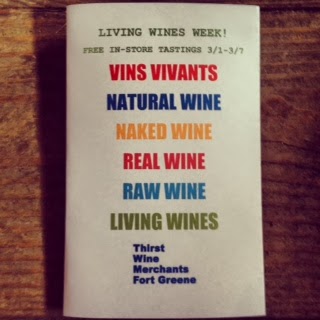

What are Living Wines? 
Come see and taste for yourself. They're wines made with care in the vineyard by individuals who farm organically and/or biodynamically and who naturally ferment their wines with nothing added or taken away except, perhaps, a homeopathic dose of sulfur. These are the opposite of mass-produced wines that are commonly made with potentially hundreds of different additives and chemicals and often engineered with lab yeasts. We want to demonstrate the difference. Our goal is to bring you wines that are alive and give pleasure. 

THE SCHEDULE
Saturday, 3/1, 5-7pm: Launch with Staff and A Thirst Merchant Selection or few
Sunday, 3/2 5-7pm: Byron Bates, Goatboy Selections
Monday, 3/3, 6-8pm: Kreso Petrekovic, Zev Rovine Selections
Tuesday, 3/4, 6-8pm: Maya Pedersen, Louis/Dressner Selections
Wednesday, 3/5, 6-8pm: Steven Plant, David Bowler Wine
Thursday, 3/6, 6-8pm: Chris Terrell, Terrell Wines
Friday, 3/7, 6-8pm: FINALE! (with a couple of surprises)

Tyler on why he likes working at our shop: 

We sell the type of wine I like to drink.

There is no shortage of descriptors for the bottles which line our shelves, each suggesting a unifying theme for a wild, nuanced world of wine. At the end of the day, what matters is that the glass we fill contains a living, honest liquid which was extracted from the ground with both consideration and trust. I don't know if there's truly a word for that. To be honest, I'm not sure there needs to be. 

The kinds of wine we sell - and, in turn, I drink - are the kinds of wine which interrupt a thought. They create a pause in conversation, they confront us, and we're forced to react. "How is this just grape juice?" We pour these wines, we take a sip, and then we look at the glass. "This is so freaking good." Of course, there's a lot more to it. Through our tastings this week, I hope that we can create a discussion about what exactly that is. We can talk about soil and sulfur and governmental regulations and fermentation and packaging and grapes and all of that. That stuff is really important. Until then, we can keep things simple. 

I'm proud to sell wine which aren't afraid to make a statement. There is an energy in these bottles, and I have yet to find the right word for it. For now, I'll settle with "ours."

Thursday, April 11, 2013

Where Soif Meets Sagesse: Laurent Barth

The story of Laurent Barth is a dear one, because the honoring of a family legacy and terroir is done in large part by a strong commitment to restoring the soil with the eradication of chemicals. 

"I have a link to my family's land, and I'm proud it finally has the Barth name on it. The idea was always to make wine from my village." 

Laurent Barth

Laurent Barth went to wine school in Burgundy, as many sons whose fathers grow grapes in France tend to do, and so he set off around the world in search of a true path, living and working on estates in Libya, South Africa, the US (California), India, and even Australia, before returning home. Barth honored his father's existing contracts for a few years, selling grapes to the local co-op, in the meanwhile fostering his vineyards with organic techniques he learned to improve the soil and health of the vines.  

His first vintage of estate bottling was 2004. Each year thereafter he began to experiment more and more with biodynamic techniques in the vineyard and cellar, always aiming to integrate what he'd learned with the specific realities he encountered as well as those reflected in the larger events written into the biodynamic calender. Restoring the proper use of sulfur, which had for years been abused--it has so completely damaged the reputation of Alsatian wines that to this day one sees a preference for Austrian or German whites from all but the most discriminating sommeliers. Another imperative for him is to use only indigenous yeasts; not for doctrinaire reasons, but "if the grapes are clean, if they are well selected at harvest, you get much more substance," says Barth. 

Just as he was patient to transform his father's vines into his own, Barth has been equally patient in his cellar, allowing for fermentation to take its time, a small "price to pay for complexity" in the wine that comes out of it. We're offering proof of the payoff of Barth's wanderings and patient arrival back in his hometown of Bennwihr in the form of a cornucopia of old-vine cuvées. 

While many 2011 wines have been long on the market (now 2012s are even showing up!), Barth is just now releasing his 2011s as their élevage has brought them to a stage where soif (thirst) meets sagesse (wisdom), reminding us quietly that Alsatian wine can be some of the most pleasantly drinkable wine on Earth. We're clearing off a major portion on our shelves to make room for these wines--because these are wines that will transport you to a place that's somewhere special. Bennwihr, north of Colmar in Alsace, is where you'll be.

Barth Gewurtztraminer Les Clos des Trois Chemins 2010, $25
Barth Pinot [Blanc] d'Alsace 2011, $15
Barth Pinot Noir 2011, $23
Barth Pinot Noir M 2011, $31
Barth Racines Metisses 2011, $17
Barth Riesling Vieilles Vignes 2011, $24

Try all six for only $125 or save 10% off eight or more! Click here to order some.

Wednesday, January 16, 2013

Howling at the Moon: Bruno Duchene


Something profound is irrevocably lost when machines flatten hills and monoculture is introduced. Rows and rows and rows seemingly ad infinitum of the same GMO produce, and hormones and antibiotics used when raising animals in factory farms, are ultra efficient, but also devastating and polluting, and tend to produce ingredients that are neither flavorful nor good for you.

Case in point: tomatoes. Local, in-season heirloom tomatoes grown organically out-do their so-called conventionally-grown beefsteak super-market clones in taste yet we in Brooklyn have a short window to enjoy them. In addition, they tend to be more expensive, harder to find, more delicate to handle, and thus prohibitive to distribute widely.

Along the same lines, winemakers organically working dry-farmed vineyards on challenging slopes with low yields, produce healthy grapes and expressive wines full of character reflective of where they're grown; in contrast to those made, for instance, by Big Brand Wine Companies (three such companies control more than 50% of wine sales in the US) who largely make wine from irrigated flatlands that are easier to manage, have significantly higher yields, and whose wines, to be charitable, lack character.

Bruno Duchene
Our winemakers relish the challenge of meeting their vineyards on their own terms and making from them pure, hand-made wines. For us, such efforts can be a revelation in a bottle, can unearth, as it were, a taste of "terroir."

Without exaggeration (and we say this rarely), Bruno Duchene -- no stranger to the delicacies of wilder nature (for a time, he was a dealer in wild mushrooms in the Loire Valley) -- is performing feats on arduous, sun-baked, terraced hills in Banyuls and Couillure worthy of the admiration we more often give to winemakers who work, for instance, the steep slopes of Cornas, the Mosel, or Valtellina. 

Four hectares (about eight acres) is plenty for Bruno to deal with. The yields are naturally extremely low on his organically farmed plots of forty- to sixty-five-year-old vines of Grenache and Carignan. In fact, many of his neighbors have abandoned their legendary sites because the vineyards are so hard to work; those who haven't often vinify this meaty grape juice in a manner that tries to out-do other Languedoc monster trucks or Chateauneuf-du-Papes. Bruno takes the powerful potentiality of his terroir and does a complete one-eighty. He ferments the grapes (grown organically with few treatments in the vineyard, no copper, for example) whole cluster with very little fussing about (in tech talk, no remontage and barely any pigeage), with most of the wine done in large vats and just a little with old barrel treatment for balance. The delicacy of his approach is akin to Eric Texier's style of just-enough extraction, which allows the wine to retain some translucency that gives a window to the flavors of a place; allowing for a new standard of what it means to say a wine is balanced when it's from this region.


Bruno Duchene's "La Luna" really is an absolute gamechanger, a vin de soif from a "heady" region -- the village of Banyuls, famous for their fortified Grenache-based dessert wines of meditation -- is here repurposed with a greater solar influence, drawing the wine's terroir up and out. If schist could float, this is it. Unmistakable aromas draw you in to taste a sap-like quality that's as succulent as can be, the Grenache is not over-done or too "varietal." The 13.5% alcohol, vivid palette, a breezy succulence on the palate, and as enduring as it should be without any extra baggage -- just the right amount of time in the sun.

If we had to make hydra-headed comparisons, this wine reminds us of the clarity of Yannick Pelletier's Saint Chinians but with the generous and then snappy quality of some of the best sans soufre Anjou rogues out there. As his acreage and yields are so low, you can imagine how small his production is. We have less than four cases (which is a lot!) available, so first come, first served.*

The 2011 Vin de Pays de la Cote Vermeille "La Luna" from Bruno Duchene is $25 per bottle, $89 for four.

*Those who purchase the "La Luna" cuvee will get first chance at his even smaller-batch Coillure AOC wines when they become available, thanks.

To order: email us, call us at 718-596-7643, or stop by the shop! 

Thursday, January 10, 2013

New Year, New You: Elodie Balme

We at Thirst Wine Merchants believe there's a way to make a New Year's Resolution that dissolves headaches rather than creates them. Now the jury's still out on why it is that natural wines are decidedly better for you; whether it's the lack of extraneous petro-chemicals, added artificial flavors, artificial yeasts, or the healthier soil (and thus grapes) and natural yeast, resulting in sips with more flavor -- or the lower-to-nil added sulfur -- or other natural compounds that are not eradicated by herbicides or pesticides in the vineyard. We're not scientists, but a confluence of factors and experiences have us resolved to drink -- and sell -- only wines made as naturally as possible.


The young and talented Elodie Balme is a great example of our type of independent winemaker. She makes the kind of wine that we decided we were going to represent in our store when we opened in 2006. 2006, in fact, was her first vintage! She was selling wines when she realized she was more interested in making wine; she decided to study viticulture and oenology and to work part-time for the influential Marcel Richaud, who makes phenomenal organic, naturally fermented wines based in Cairanne, a village in the Côtes du Rhône, for almost forty years now. Marcel is also active in the association of natural winemakers in France (Association des Vins Naturels) and believes, as do we, that "real wine is wine that sees no chemical treatment, no filtering, no commercial yeasts and no other technique that would specifically alter a wine." 

Marcel encouraged Elodie to become an independent vigneronne, telling her "there's always room for you when you're motivated to work well." Elodie returned home to make wine and began re-calibrating what were her father's vineyards by eliminating chemical pesticides and herbicides and converting to organic farming informed by biodynamic principles. Her approach is centered on attaining eminently drinkable wines rather than following a set of dogmas in the abstract. 
  
Elodie also cites influences from numerous other vignerons, young and old, whose work we also sell in our shop from the Loire, Languedoc, Champagne. (Please inquire if you want to know more.)

Although Elodie's father has not been completely convinced of her natural methods (parents take time, no?) such as minimal sulfur usage at only the most robust stages of fermentation and bottling, we are inspired by her quick ascension to making thirst-quenching wines and are stoked to have locked down a nice allocation of her 2011 wines that just arrived and to share them with you. Elodie wants you to actually drink and enjoy some of these wines in their youth, and their ethical pricing reflects a commitment that allows you to relax about opening them now.


2011 Elodie Balme Vin de France Rouge

We'll start with her Vin de France from Vaucluse, which is made from Grenache, Carignan and Merlot. The Grenache comes from a single hectare (about two acres) of forty-year old vines in the sandy village of Roaix, river-side Carignan of equal age, and young vines Merlot (hence the Vin de France designation -- this Bordeaux varietal is not allowed under the strict Rhône regulations for Appellation status) to complete the blend. Elodie's Vin de France potentially takes the cake for the most versatile, drinkable, party-friendly Rhône red we've tasted in a while.  The balance is impeccable, albeit with ripe black fruit that's not intensely dry so you can enjoy it even on its own.
  
2011 Elodie Balme Côtes du Rhône Villages Roaix "Champs Libres" Rouge
Drink her Vin de France casually, but for more serious cooking, Elodie's single-village Roaix has a more roasted meat quality, with Mourvedre entering the blend to give the wine grip, texture, and tension, as well as serious depth on the nose and an energetic, vigorous finish.  Both wines are showing phenomenally well, proving that the Mediterranean sun of this region will warm your winter cooking appropriately.
  
Elodie's Vaucluse is $15 per bottle, the Roaix $18 -- buy a combo six-pack of four Vaucluse and two Roaix for only $89.

To order any of these wines, email us! 

Tuesday, May 8, 2012

Sicily


This month, come with us to Sicily! Emilia and I were there in March visiting producers with Kevin McKenna from Louis/Dressner and it was, well, downright revelatory.

Mt. Etna from an I Vigneri Vineyard

Salvo Foti has revived a 15th Century Mt. Etna winegrowers’ guild, I Vigneri di Salvo Foti. The wines I Vigneri make are truly representative of this special place. Salvo has also been a consulting winemaker for some of the best wineries in the area.
The I Vigneri team share a passion, a fervor, for what they do. Their aim is ”to avoid the damage that over-reaching ambition and egoism can cause.” They are hands-on, work organically in both the vineyard and the cellar, use non-invasive methods and systems, and have a deep respect for the local traditions. For them, it’s all about the pleasure of work well done, being in harmony with their environment, and patiently working a one-of-a-kind terroir that's been deeply marked and shaped by the active volcano that is Mt. Etna.
Their vineyards are heterogeneous, with young vines living alongside the not-so-young and the rather ancient. Different varieties and variants of the same variety thrive together, each bringing something valuable to the creation of a unique yet typical wine. Shunning easy answers like biotechnological superyeasts and superenzymes, they make wine the way it should be made: just grapes!
I Vigneri di Salvo Foti, Sicilia IGT Rosato Vinudilice 2009
Vinudilice is a rosé that's produced from their Bosco vineyard, which is one of the highest in Europe (1,300 meters or 4,265 feet above sea level). It’s nestled in a vast forest of holly oaks in the territory of Bronte -- the Sicilian name of the holly oak, ilice, gives the wine its name. The wine is made from the indigenous grape varietals Alicante, Grecanico, Minnella, and a small quantity of other even more obscure local varietals.

The Bosco vineyard is tiny, 0.35 hectares (0.86 acres), and more than a century old. It’s planted using an Etnean alberello (bush-training) system in a 1 meter by 1 meter scheme, equivalent to 10,000 vines per hectare, and is cultivated by hand, with more than a little help from their mule. The wine is vinified in wooden vats without refrigeration or added yeasts or filtration. Decanting and bottling follow the phases of the moon.

Vinudilice is normally a still wine but the 2009 vintage of this wine had a happy accident: a second fermentation in the bottle that’s created a simply lovely sparkling rosè. It pairs great with spaghetti with a spicy tomato sauce.

Arianna Occhipinti & Kevin McKenna

At 29, Arianna Occhipinti is a rising star. It’s truly amazing how much she’s already accomplished at such a young age. When we tasted through several vintages of hers with her at her home, it was frankly astounding how well some of the first wines she made, her 2004s, have aged. And her future looks even brighter.

Because she was feeling cramped at her current winery, Arianna jumped at the chance to buy a beautiful but run-down property across and down the road that will allow her over the next several years to spread her wings even wider and fly even higher. Her boyfriend, an architect like her father, is helping her on the project.

Tami IGT Sicilia Bianco Grillo 2010
Tami is Arianna’s second label with and her aim with it is to make uncompromising but more affordable wines for everyday drinking. Her boyfriend also has a combination wine, book & design store called Tami in the ancient town of Siracusa. For her Tami wines, Arianna sources the grapes from neighbors. As with her other wines, it’s made using indigenous yeasts.

Grillo is a grape most closely identified with the production of another Sicilian wine: Marsala. Here, however, it’s rendered in a dynamic, fresh, clean, fruity style. Drink it with a simply grilled fish from Pura Vida at Saturday’s Fort Greene Farmers’ Market!

If these wines pique your interest, click here to sign up for our club at the $25, $50, or $100 level and we'll get you started.

Thursday, October 23, 2008

A Peek into the Life of a Wine Merchant

Tuesday: The well-attended, festive Louis/Dressner National Tasting/20th Birthday Celebration. Taste hundreds of mind-bogglingly Real Wines in as coherent a fashion as possible, eat delicious food (thanks, largely, to the M in LDM, Kevin McKenna, I think), meet Joe’s rightfully proud mother (again), linger over the ’88 table, and schmooze with the glittering natural wine cognoscenti. Here’s to another 20 years!

Wednesday: A surprise dinner invite from my favorite contemporary sax player, Bill McHenry. Bill made a convivial Indian feast and regaled and inspired all of us with his wise insights into the human condition. Bill, thank you!

Tonight, from 6-8, Michael Messenie from Savio Soares returns for an in-store tasting. Mike will pour two Mittelrhein wines from Matthieu Muller (an 07 Kabinett Trocken with 8.8 grams of residual sugar and an 06 Spatlese with 101 grams of residual sugar) and a Mosel made by Michael Boch (a Beerenauslese with 161.5 grams of residual sugar). Savio himself is expected to drop by. We’re looking forward to dinner after hours with Savio and Mike -- an opportunity to taste more of Savio’s wines

Tomorrow, Friday, from 6-8, a Kermit Lynch Lollapalooza! featuring Christine Boucard, Domaine Chanteleuserie (Bourgeuil), Claude-Edouard Geoffray, Chateau Thivin (Cote de Brouilly, Brouilly), Olivier Savary, Domaine Savary (Chablis), Marie Zabalia, Chateau Saint Martin de la Garrigue (Coteaux du Languedoc), Fabrice Amiot, Domaine Guy Amiot (Chassagne-Montrachet) and Bruce Neyers, Neyers Vineyards (St. Helena, CA--and the National Sales Director for KLWM). Afterward, dinner with the winemakers and more winetasting!